The bait you were never meant to swallow
Some things really did happen.
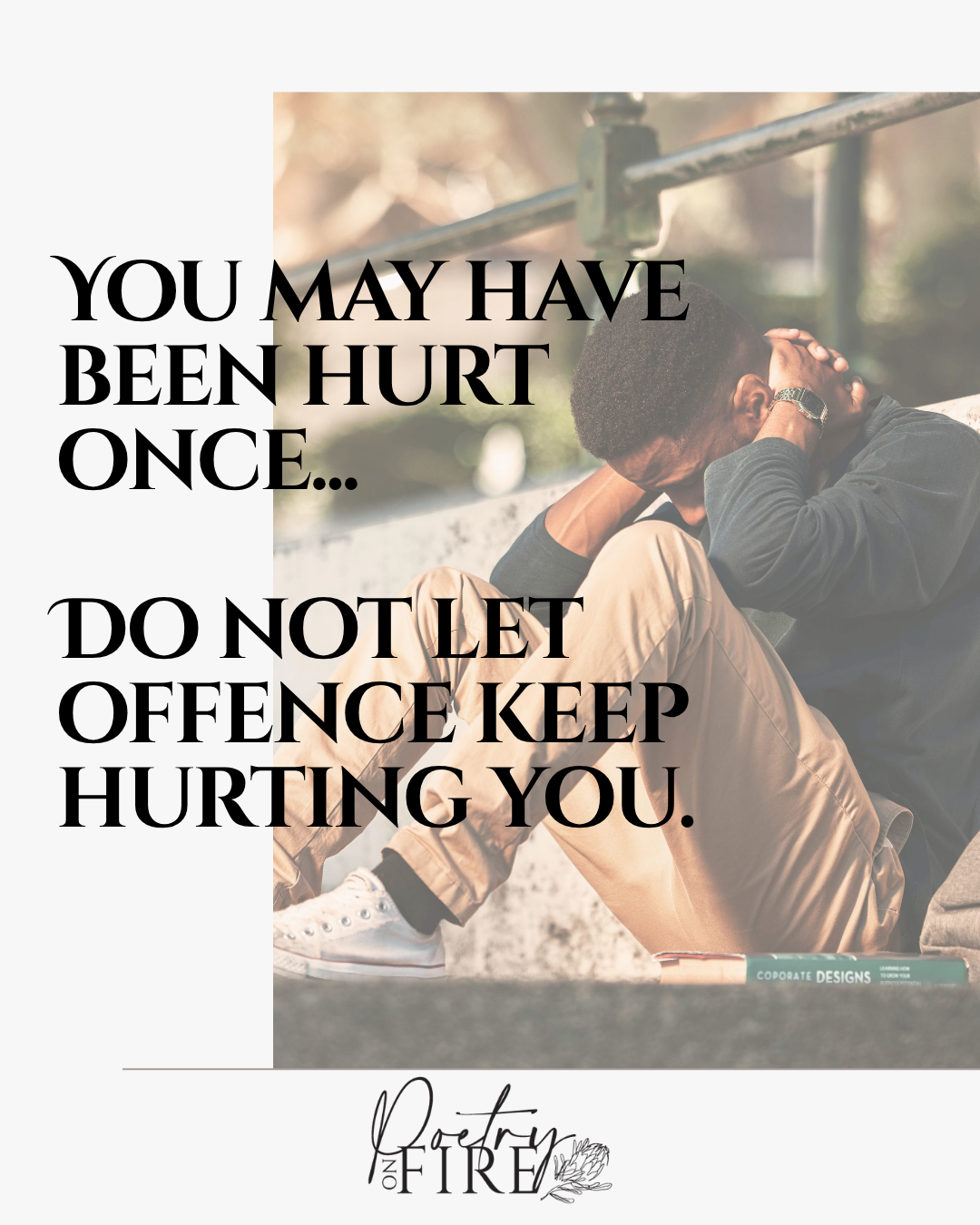
You were not imagining it. You did not misunderstand everything. You were hurt. Someone said what they said. Someone did what they did. Perhaps you were betrayed. Perhaps you were rejected. Perhaps you were treated unfairly, spoken about, excluded, misrepresented, overlooked, dishonoured or wounded by someone you trusted.
…And THIS is where offence becomes so dangerous. Because offence does not always begin with a lie. Sometimes, it begins with something that really happened…
Jesus never told us that we would live without opportunities to become offended. In fact, He said the opposite. In Luke 17:1, Jesus said, “It is impossible that no offences should come.” Offences will come. Opportunities to take offence will come. People will disappoint us. Words will hurt us. Relationships will change. People will misunderstand us. Sometimes people will make decisions that affect us deeply. Sometimes we will be wounded by strangers. Sometimes by friends. Sometimes by family. Sometimes by people we never expected it from.
The question is not whether you will ever have an opportunity to become offended. The question is what you will do when that opportunity comes.
You may not have chosen what happened to you, but you still have a choice about what is allowed to take root in you.
That is why Proverbs 4:23 tells us, “Keep your heart with all diligence, for out of it spring the issues of life.”
Guard your heart.
Not because nothing should ever hurt you. Not because you should pretend that everything is fine. Not because what happened does not matter. But because what happens inside you after what happened to you matters more than you may realise.
Hurt and offence are not the same thing
Hurt is a wound.
Offence is what can begin to grow around the wound.
You can be genuinely hurt without becoming offended. You can acknowledge that something was wrong without allowing bitterness to take root. You can establish boundaries without hatred. You can tell the truth without dishonouring someone. You can forgive without pretending that trust has automatically been restored. You can walk away from something unhealthy and still keep your heart clean before God.
But offence wants more than acknowledgement… Offence wants occupation.
It wants space in your thoughts. It wants your attention. It wants you to replay the conversation again and again. It wants you to collect evidence. It wants you to remember every detail. It wants you to interpret everything through the lens of what happened. It wants you to tell the story until the story becomes part of your identity.
Offence does not need you to be wrong about what happened. It only needs you to keep feeding on it. That is what makes it so deceptive.
You may be completely right about what happened and still be completely wrong in what you allow it to produce inside you.
Being right does not make offence okay.
The trap of offence
The Greek word often translated as “offence” in the New Testament is connected to the word skandalon. It referred to the trigger of a trap, the part where bait was placed to lure something into captivity.
- The bait looks like the issue.
- The trap is what happens after you take it.
- The betrayal may be the bait.
- The rejection may be the bait.
- The injustice may be the bait.
- The disrespect may be the bait.
- The misunderstanding may be the bait.
But the trap is bitterness. The trap is resentment. The trap is hatred. The trap is suspicion. The trap is unforgiveness. The trap is allowing one person’s actions to change the condition of your heart.
The enemy would love for you to spend so much time looking at what someone did that you never notice what it is doing to you.
That is the trap.
- You become so focused on proving that they were wrong that you stop asking Jesus what is happening in your own heart.
- You become so committed to remembering what happened that you forget to guard what is happening now.
And without even realising it, the person who hurt you begins to occupy space in your heart that they were never meant to have…
Offence can feel like protection
One of the reasons offence is so difficult to release is because it can make us feel safe.
“If I stay angry, I will not be fooled again.”
“If I keep remembering, I will not become vulnerable again.”
“If I keep the evidence close, I will not forget who they really are.”
“If I remain suspicious, nobody will catch me off guard again.”
“If I build a wall, nobody will ever get close enough to hurt me like that again.”
Offence can disguise itself as wisdom. But wisdom and offence do not produce the same fruit.
- Wisdom can establish a boundary and still love.
- Wisdom can recognise a pattern without becoming suspicious of everyone.
- Wisdom can say no without hatred.
- Wisdom can walk away without needing to destroy someone on the way out.
- Wisdom can remember the lesson without continually reliving the wound.
Offence, however, keeps the wound alive.
It tells you that replaying the pain is protecting you, when in reality it is keeping you connected to the very thing you are trying to escape. The person may no longer be in your life, but the offence still is. They left, but the conversation stayed. The moment ended, but the replay continued. The relationship changed, but the offence kept occupying space in your heart…
That is not freedom.
When the replay will not stop
Have you ever had an entire argument with someone who was not even in the room?
You remember what they said. Then you remember what you should have said. Then you imagine what they would say if you confronted them. Then you answer that. Then you defend yourself. Then you prove your point.
And the other person is not even there!!
But your body responds as though the moment is happening again… Your heart races. Your emotions rise. Your peace disappears…
That is one of the ways offence feeds itself:
Rehearsal.
Every time we continually replay the wound without bringing it into the presence of Jesus, we can deepen the pathway the offence has created.
There is a difference between processing something and rehearsing it.
- Processing moves towards healing.
- Rehearsing keeps returning to the scene.
- Processing asks, “Jesus, what do You want to heal in me?”
- Rehearsing asks, “How could they do this to me?”
- Processing allows Truth to enter.
- Rehearsing keeps presenting the same evidence to the same internal courtroom.
At some point, you have to stop retrying a case in your mind that you have already placed into the hands of God.
Romans 12:19 says, “Beloved, do not avenge yourselves, but rather give place to wrath; for it is written, ‘Vengeance is Mine, I will repay,’ says the Lord.”
God saw it. God heard it. God knows.
You do not have to keep the case alive to make sure He remembers.
I have to put in a disclaimer here: This is also an area the enemy abuses to make us think we have not dealt with offence when we really have… We are a spirit, we have a soul (our mind, will, and emotions), and we live in a body. Our spirit can be completely healed, walking fully in forgiveness, and offence can be something we have let go of fully by the grace of God. However, what often happens, is that when we are faced with the person tied to the offence we dealt with, we most likely can have a physical reaction to seeing them. This is our parasympathetic system, totally out of our control, reacting to something our soul notices as having hurt us before. We might become red in the face, our heart can start racing, we might even start shaking… And this is where we need to be secure in our relationship with Jesus. We need to be able to discern if the bodily reaction is just that, a biological reaction to something that happened in our past, or if offence is still present in our hearts. In these moments, take a deep breath, imagine how you are breathing in Jesus and exhaling every negative emotion and memory. You will quickly realise that your body reacted to something that has already been dealt with in your spirit. The bodily reaction does not mean that you are not healed.
A healed heart is able to discern that even though there was a physiological reaction, the spirit is strong, healthy, restored – and the bodily reaction does not prove offence is still present in our hearts. Ask the Lord for wisdom to discern when your body is reacting, or when you are still carrying offence in your heart.
Offence changes the way you see
One of the most dangerous things about offence is that it becomes a filter.
Once offence takes root, we stop seeing only what is happening. We begin seeing everything through what happened.
- A delayed response becomes rejection.
- A correction becomes an attack.
- A boundary becomes punishment.
- Someone else’s success feels personal.
- A conversation we were not included in becomes evidence.
- A facial expression becomes confirmation.
- Silence becomes a statement.
We begin filling in gaps with assumptions, and because our hearts are wounded, those assumptions often agree with our pain.
The picture I always see when I think of this specific aspect of the effects of offence on our lives, is one of offended people walking around with “a fence” [offence]. Imagine navigating every step you take, every conversation you have, every seat you take, every friend you visit, every meeting you attend with “a fence” that you are carrying with you.
- You will be constantly aware of the fence you are carrying.
- You will continuously try to change your positioning to just have a moment to breathe.
- Your focus on this fence will affect how you interact, perceive and feel about the people around you, where to stand, how to sit, where you can enter, where the fence won’t fit and therefore you cannot enter.
- This fence you are carrying with you, is never put down, it is even with you when you are sleeping – the fence goes to bed with you. Imagine how your sleep will be affected with a fence in the bed!!
- When you are talking to people you are either talking through the fence, or you are carrying the weight of the fence on your shoulders and the whole conversation is lost to you – a recipe for misunderstanding and further offence to be experienced.
- Offence fences us in to a point where it affects every relationship, every aspect of our lives, every activity we are participating in…the person we become.
And all we have to do to be lighter, more comfortable to be ourselves, more open to have conversations, and walk into a boardroom with confidence…is to put down “a fence.” Just lay it down.
This is why guarding your heart is so important.
A wounded heart needs healing.
An offended heart begins building a worldview around the wound, the fence that stands between that heart and everything and everyone else.
Hebrews 12:15 warns us to look diligently at our hearts “lest any root of bitterness springing up cause trouble, and by this many become defiled.”
Roots grow beneath the surface before fruit becomes visible.
- Offence can sit beneath a smile.
- Bitterness can sit beneath service.
- Resentment can sit beneath worship.
A person can continue functioning while something unhealthy is growing underneath.
And eventually, what is rooted in the heart begins to affect more than the person carrying it…
“By this many become defiled.”
Offence spreads.
Be watchful who you invite into the offence you are experiencing
When we are hurt, we naturally want someone to understand.
There is nothing wrong with seeking wise counsel. That is the Word, it is Godly. There is nothing wrong with processing pain with someone trustworthy, Jesus did the same in the Garden of Gethsemane. There is nothing wrong with asking for prayer, help or perspective, that is Biblical.
But there is a difference between seeking counsel and recruiting agreement.
Offence loves an audience. It wants someone to say, “You are right.” Then another person. Then another. And before long, what began between two people has entered the hearts of ten. I have often commented that it seems as if people who are offended carry a sign around their necks in the spiritual realm, and they just find each other! If not dealt with, I have seen groups of offended people walking together, absolutely certain that they are right to feel the way they feel…
We must be very watchful that in trying to prove what happened to us, we do not plant something unhealthy in someone else. This is something we all need to look inward for to determine… Even though I did not mean it, I have planted unhealthy seeds in people’s hearts as I was trying to explain how what happened to me was wrong.
- However, we can tell the Truth and still tell it with the wrong spirit.
- We can share facts and still be feeding offence.
- We can call it processing while repeatedly telling the story to people who cannot help bring healing, wisdom or resolution to the situation.
Here is a test you can take yourself through before you share the challenge you are facing with anyone:
- Ask yourself honestly:
- Why am I telling this person?
- Am I looking for wisdom?
- Am I looking for prayer?
- Am I looking for help?
- Or am I looking for them to agree with the offence I am carrying?
Guarding your heart also means guarding what leaves your mouth while your heart is hurting.
Luke 6:45 tells us, “For out of the abundance of the heart the mouth speaks.”
Eventually, what is filling your heart will find your voice…
Forgiveness does not mean what happened was acceptable
Many people hold onto offence because they misunderstand forgiveness. This is one of the most important truths Christians need to understand for them to move forward and live healthy lives, becoming more and more like Jesus every day.
- Forgiveness does not say that what happened was right.
- Forgiveness does not erase accountability.
- Forgiveness does not mean there should be no consequences.
- Forgiveness does not automatically restore trust.
- Forgiveness does not always mean reconciliation is possible, although the Word encourages us to live at peace with everyone as far as it depends on us (Romans 12:18).
- Forgiveness does not ignore, block, or gossip.
- Forgiveness trusts God for us to have clean hands and a pure heart towards the person we have forgiven.
- Forgiveness does not mean giving someone the same access to you that they had before.
- You can forgive someone and still have a boundary – not “a fence,” not a wall, a healthy boundary.
- You can release someone and still recognise that the relationship cannot continue in the same way it had before.
- You can love someone and not trust them with the same things you used to, and that is okay.
- You can pray for someone and still say no when a boundary is overstepped.
Forgiveness is not pretending.
Forgiveness is releasing your right to personally collect the debt. It is placing the matter into the hands of God and refusing to let the offence become lord over your heart.
Jesus did not ask us to forgive because what happened was insignificant.
He asks us to forgive because freedom matters.
What if they never apologise?
This is where offence often digs in deeply.
- “I will forgive when they acknowledge what they did.”
- “I will release it when they apologise.”
- “I will move on when they understand how badly they hurt me.”
But what if they never do?
-What if they never understand?
-What if they remember the situation differently?
-What if they believe they were right?
-What if the apology never comes?
-Will your freedom remain dependent on their self-awareness?
That gives another person far too much authority over your heart.
Forgiveness cannot depend on the offender becoming the person you needed them to be.
Sometimes closure does not come through a conversation.
Sometimes closure comes when you decide that Jesus is enough to lead you out of the place where someone left you wounded.
- You do not need their apology to begin healing.
- You do not need their understanding to obey God.
- You do not need them to admit everything before you can release the offence.
Your freedom belongs to Jesus.
Sometimes we are the offended one
And sometimes, if we are truly honest, we are the offender. This is a tough one to admit. But it doesn’t have to be. The enemy places pride in our hearts to stop us from taking responsibility when we are the ones who placed that fence in someone’s life… The Word says that “pride comes before a fall” – Proverbs 16:18. If pride prevents us from admitting we were the source of offence in someone’s life, it won’t be long before things start falling apart.
This is where guarding our hearts requires humility.
It is easy to read a message about offence and immediately think about the person who hurt us.
- It is harder to ask, “Jesus, have I hurt someone?”
- Have I dismissed someone’s pain because I did not intend to cause it?
- Have I defended my intentions instead of listening to the impact of my actions?
- Have I used Scripture to avoid accountability?
- Have I expected grace for myself while demanding perfection from others?
- Have I spoken carelessly?
- Have I withdrawn without explanation?
- Have I made assumptions?
- Have I allowed my own wounds to wound someone else?
Sometimes the most Christlike thing we can do is say, “I was wrong. I am sorry. I should not have done that.”
No explanation. No defence of what you say or did. No “but”. No counter accusation. No attempt to make the other person equally guilty before we take responsibility for our own actions. Not the typical “I am sorry if you felt like that.” That is not taking responsibility. That is placing the responsibility on the other person because they were the one that felt offended. That is not an apology. That is fake Christianese “apologies” that are way too rampant in the Body… We need to learn how to honestly, purely, without expecting anything in return, apologise for our actions.
Just clean hands and a pure heart.
We cannot ask others to release offence while refusing to take responsibility when we have given it.
Jesus understands offence
- Jesus was betrayed by someone who sat at His table.
- Denied by someone who said he would die for Him.
- Abandoned by people who had walked closely with Him.
- Misrepresented.
- Falsely accused.
- Mocked.
- Rejected.
- Crucified.
If anyone had a legitimate reason to hold offence, it was Jesus.
Yet on the Cross, He said, “Father, forgive them, for they do not know what they do” (Luke 23:34).
Jesus did not deny the evil being done.
He did not call injustice good.
He did not pretend the Cross did not hurt.
But He refused to allow the sin of people to change the nature of His heart.
THAT is our example.
The goal is not to become people who cannot be hurt. The goal is to become people whose hearts remain surrendered to Jesus even when we are.
-Tender does not mean weak.
-Forgiving does not mean foolish.
-Loving does not mean having no boundaries.
Guarding your heart does not mean becoming unreachable. It means refusing to let what happened to you decide who you become.
Living Poetry on Fire
So how do we actually guard our hearts against offence?
- We begin by being honest.
- We do not call bitterness discernment.
- We do not dub unforgiveness a boundary.
- We never call rehearsing the story processing what happened.
- We do not call suspicion wisdom.
- And we never call hatred accountability.
Ask Jesus to search your heart.
Psalm 139:23 to 24 says, “Search me, O God, and know my heart; try me, and know my anxieties; and see if there is any wicked way in me, and lead me in the way everlasting.”
- Bring the person before Jesus.
- Bring the conversation.
- Bring the betrayal.
- Bring the rejection.
- Bring the injustice.
- Bring the thing you still replay when nobody knows you are replaying it.
- Tell Jesus exactly where it hurts.
- And then make a decision.
- Not a feeling.
- A decision:
- “I forgive.”
You may need to make that decision again tomorrow when the memory returns. And again next week. Forgiveness is sometimes a moment. Sometimes it is a decision we continue to enforce every time the offence tries to return. Like everything else, we also forgive by faith.
STOP!!
- Stop feeding the offence.
- Stop visiting conversations that keep poisoning you.
- Stop checking what they are doing if every time you do, your heart becomes disturbed.
- Stop telling the story to people who cannot help you heal.
- Stop waiting for them to suffer before you allow yourself to live.
- Bless them – in words, actions and deeds, whether they know it is you or not.
- Pray for them.
- Not performatively. Not through gritted teeth while secretly hoping God corrects them dramatically.
- Ask Jesus to work in their lives.
- I remember a time God asked me to pray for people that hurt me… I would force myself to speak God’s Word over them, declare His promises and blessings over them, asking God to open doors for them, that He will give them the desires of their hearts…
- And all along while this was coming out of my mouth, my mind was saying “Jesus, PLEASE don’t bless them, don’t open those doors…”
- But the more diligently I prayed for them, the more I truly wanted those things for them.
- My heart towards them had completely changed just because I chose to be a doer of the Word – to pray for them and bless them! It was supernatural!
And in this process, ask Jesus to work in your heart.
Then guard your heart.
- Not with concrete walls.
- With Truth.
- With forgiveness.
- With wisdom.
- With healthy boundaries.
- With the Word.
- With the presence of Jesus.
You may not be able to control whether the opportunity for offence comes.
But you can decide whether it gets to stay.
Be a Wildfire
Our world does not need more offended Christians. There are way too many already…and most of them do not want to be honest enough to ask the Lord if there is offence in their hearts… Don’t be that type of Christian. Be a doer. DO the Word.
The worlds also does not need more believers using public platforms to settle private wounds.
It does not need more people carrying the Name of Jesus while carrying bitterness towards one another. Does it even make sense to try and carry both of those together? That is not how a true doer of the Word lives their life, it is impossible to, for the same heart cannot carry bitterness and the presence of God, and represent Him well…
The world needs people who demonstrate another way.
- People who can be hurt and still heal.
- People who can be wronged and still walk in integrity.
- People who can establish boundaries without becoming cruel.
- People who can tell the truth without destroying people.
- People who can forgive without becoming foolish.
- People who can apologise without defending themselves.
- People who can disagree without dishonour.
- People whose hearts remain tender in a world that constantly gives us reasons to become hard.
That is a wildfire.
Not a fire that destroys everything in its path.
A fire that carries the presence of Jesus wherever it goes.
Offence will come.
Jesus told us that.
But offence does not have to stay.
The enemy may have had no control over what they did to you, but he would love to use what they did to gain access to what happens inside you.
Do not give him the second victory.
What happened may have hurt you. It does NOT get to own you.
What they said may have wounded you. It does NOT get to define you.
What they did may have changed the relationship. It does NOT get to change the nature of your heart.
Guard your heart.
Release the offence.
Keep your hands clean.
Keep your heart tender.
And keep burning for Jesus.